
With aerospace production schedules rising, order books strengthening, and delivery rates accelerating across global programmes, UK manufacturing is standing at a pivotal moment. Yet despite the clear opportunity ahead, new data shows apprenticeship growth in manufacturing and engineering (M&E) remains almost flat — a warning sign for a sector already grappling with an ageing workforce and a widening skills gap.
Fresh analysis of Department for Education figures reveals just a 0.6% increase in M&E apprenticeship starts over the past year, rising only marginally from 45,800 to 46,070. Starts remain significantly below the 2019/20 peak of 52,000, while demand for technical roles — from machining and engineering technicians to digital specialists — continues to surge.
For Shaun Rowley, Managing Director of Atherstone-based aerospace manufacturer ANT Industries, the message is clear: the UK must invest heavily in its future talent pipeline, or risk missing the biggest aerospace upturn in a generation.
“Aerospace is growing fast. Schedules are becoming more ambitious, orders are climbing, and customers need more capacity from suppliers like us,” Rowley says.
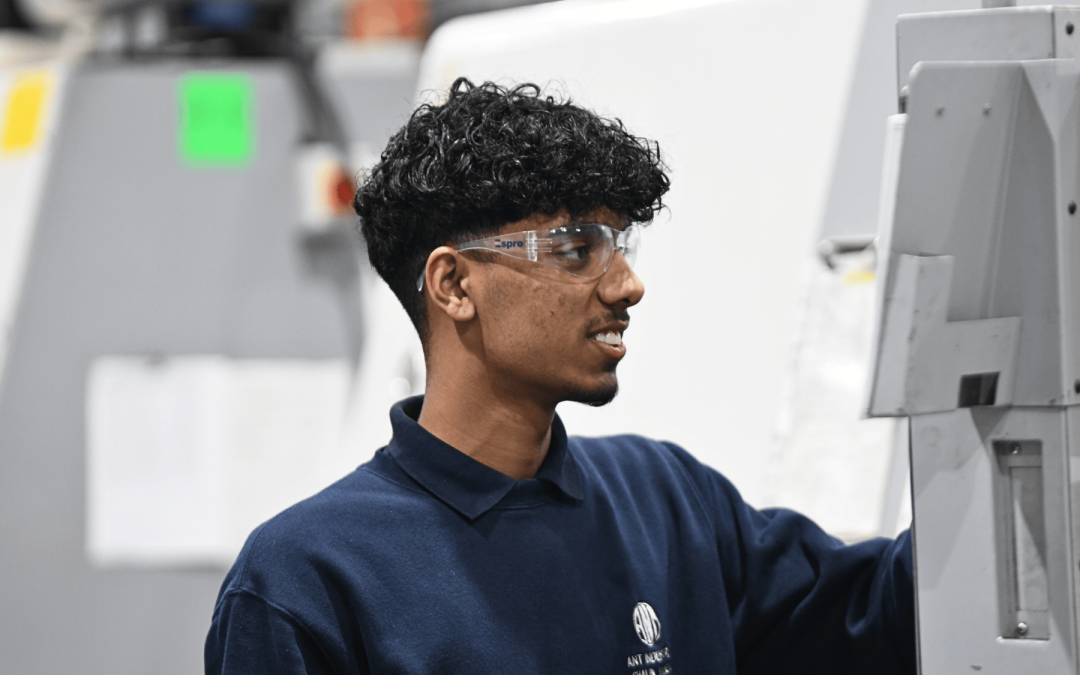
“But none of that matters if the industry doesn’t have the people. The skills gap is already real — and unless we focus relentlessly on developing young talent, we will fall short of the opportunity in front of us. We are really pleased to have some fantastic apprentices in the business currently, Hannah Naylor and Shalin Sandhu reflect the future of our sector and their enthusiasm and energy is crucial to our future”
The challenge is not theoretical. Across the sector, machining technicians, CNC operators, inspectors and engineering technicians remain in short supply. While some roles — such as machining technician apprenticeships, which jumped from 250 to 1,200 starts — are beginning to show positive growth, this is nowhere near enough to offset a decade of declining apprenticeship numbers.
Meanwhile, the rise of digital manufacturing has created new demand for hybrid-skilled engineers. Digital apprenticeships are now the fourth most popular pathway, with 31,620 starts — a sign that industry must integrate digital and traditional engineering skills more strategically.
Rowley believes the future of aerospace manufacturing lies precisely in this blend of advanced machining, metrology, automation and digital capability.
“The engines and structures we machine today are more complex than ever. Five-axis, mill-turn, digital inspection, data-driven machining — these aren’t niche skills anymore, they’re standard,” he says.
“We need a new generation of engineers who are equally comfortable at a machine, at a CAD station, or analysing data. That only happens if industry invests early and consistently.”
The government’s announcement this month of 50,000 new youth apprenticeships — removing the 5% training levy for under-25s — has been welcomed by manufacturers. However, rising employment costs, including significant increases to the National Minimum Wage and National Insurance, continue to make apprenticeships expensive for SMEs.
Some smaller engineering firms have already warned they may have to reduce intake in 2026, despite long-term shortages in roles such as welding, machining, and maintenance engineering.
Rowley says the answer is not to retreat, but to rethink.
“We can’t treat apprenticeships as a cost — they are an investment in the future of UK manufacturing,” he argues.
“The firms who continue bringing in young people, even when times are tough, will be the ones with the strongest capability when aerospace demand peaks. At ANT, we are absolutely committed to growing our early-career talent base.”
ANT Industries has intensified its own investment in apprenticeships, technical training and MTC-backed development programmes in recent years, positioning itself to support growth from leading customers including Rolls-Royce, ITP Aero, Siemens and Eaton Aerospace.
The company recently celebrated apprentice engineer Hannah Naylor, who received the MTC’s prestigious Extra Mile Award for outstanding performance — a powerful example, Rowley says, of what happens when young engineers are nurtured early.
“Hannah is a reminder that the next generation is full of ability, energy and ambition,” he says.
“Our job — and the job of UK manufacturing more broadly — is to give people like her the opportunity, the training and the environment to thrive.”
With global aerospace forecast to grow steadily through the next decade, the UK has a historic opportunity to strengthen its manufacturing base — but only if companies and policymakers act decisively.
Rowley’s message is clear:
The skills gap is a strategic threat. However, it’s also a solvable one. If industry, educators and government work together, we can build a talent pipeline that secures British manufacturing for the long term.