
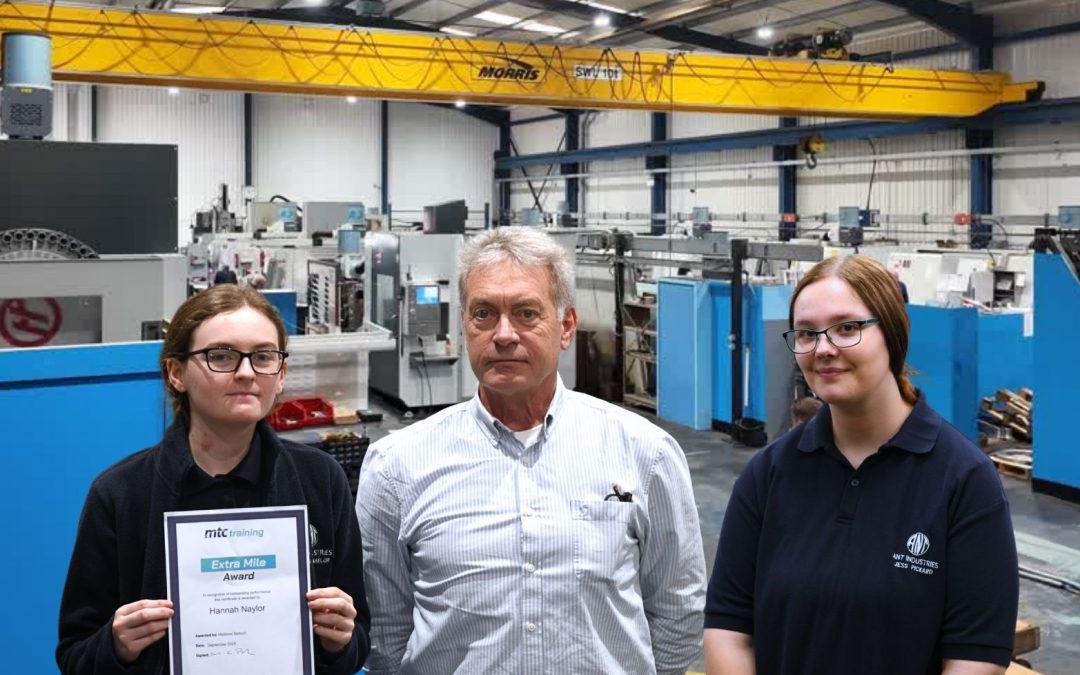
As the banners come down on National Apprenticeship Week and manufacturers return their focus to delivery schedules, investment plans and order books, one question remains: who will pass on the craft? Across UK industry, apprenticeship numbers remain a priority for policymakers and business leaders alike. For companies like ANT Industries in Atherstone, apprentices are not a box-ticking exercise – they are a strategic commitment to the future of precision engineering. But as Managing Director Shaun Rowley is keen to stress, recruitment is only half the story.
“It’s what happens on the shop floor, day after day, between experienced engineers and young apprentices, that truly shapes the next generation.”
For young engineers in the business such as Jess Pickard and Hannah Naylor, they are picking invaluable input and support from the experienced engineers around them. There is a real appetite and energy to learn both the practical sides of the job and the theory -and they have space to explore their role and their discipline, but there are willing and supportive team mates along side them when they need. That knowledge transfer is absolutely critical and gives them the best chance of being successful. Our senior engineers speak very highly of the attitude and calibre of our young engineers which is really promising.
The Quiet Risk Facing UK Engineering
Britain’s engineering sector is facing a subtle but significant challenge. Many of the industry’s most skilled machinists, toolmakers and production engineers are approaching retirement. They carry with them decades of tacit knowledge — the instinctive understanding of materials, tolerances, tooling behaviour and problem-solving that cannot be fully captured in manuals or CAD files.
For years, that knowledge transfer happened organically. Young engineers stood beside seasoned operators, absorbing lessons in real time: how to listen to a machine, how to spot a tolerance issue before it becomes scrap, how to approach a complex job with calm precision. Today, production pressures, lean staffing structures and accelerated project cycles mean those moments are harder to create. “There’s less time in modern manufacturing,” Rowley explains. “Everyone is working to tight deadlines, customers expect rapid turnaround, and technology is advancing quickly. But if we don’t protect time for mentorship, we risk losing knowledge that has taken decades to build.”
Apprenticeships Are the Start
ANT Industries has consistently championed apprenticeships as a core part of its workforce strategy. Apprentices bring fresh thinking, digital confidence and long-term continuity. They represent stability in a sector often challenged by skills shortages. However, Rowley is clear: structured training must be matched by structured mentorship. “Apprentices are ambitious and capable,” he says. “But they need access to experienced engineers who are willing — and empowered — to guide them. That internal support is what builds confidence, accountability and pride in workmanship.” Mentorship does more than transfer technical skill. It passes on standards, culture and judgement. In high-precision sectors where compliance and quality are paramount, that judgement is invaluable.
An apprentice can learn how to program a machine. It takes a mentor to teach them when to question a drawing, when to suggest an improvement, or when to stop a job before a small issue becomes a major failure.
Protecting Craft in a Digital Age
Manufacturing is increasingly digital, automated and data-driven — developments that companies like ANT Industries actively embrace. But even the most advanced CNC platform or inspection system relies on human insight. “There’s a misconception that technology replaces experience,” Rowley says. “In reality, technology amplifies it. The best results come when digital tools are combined with practical knowledge and engineering instinct.” By encouraging senior engineers to play an active role in developing apprentices, ANT aims to preserve both traditional craftsmanship and modern capability.
A business that fails to transfer knowledge effectively risks inconsistency, quality drift and weakened problem-solving capacity. One that invests in mentorship builds depth, stability and leadership from within. The challenge, Rowley acknowledges, is not willingness. Most experienced engineers take pride in supporting younger colleagues. The issue is time and structure. “Mentorship can’t be accidental,” he says. “It needs to be recognised as part of the job, not something done on the side when there’s a spare five minutes.”
For ANT Industries, that means consciously pairing apprentices with experienced team members, encouraging cross-functional exposure and fostering a culture where questions are welcomed rather than rushed aside. It also means recognising that mentorship is reciprocal. Young engineers bring new ideas, digital skills and different perspectives that benefit seasoned professionals. “It’s not a one-way street,” Rowley adds. “Our apprentices challenge us, too. They ask why we do things a certain way, and that keeps us sharp. The exchange strengthens the whole team.”
Beyond a Single Week
National Apprenticeship Week provides a valuable platform to celebrate young talent and highlight success stories. But sustainable skills development is built quietly, consistently and collaboratively throughout the year. For ANT Industries, the message is clear: apprenticeships are essential — but they only thrive when supported by engaged, experienced engineers willing to pass on their craft. “If we want British manufacturing to remain competitive,” Rowley concludes, “we have to invest in relationships. The future of engineering depends on today’s willingness to teach.”