
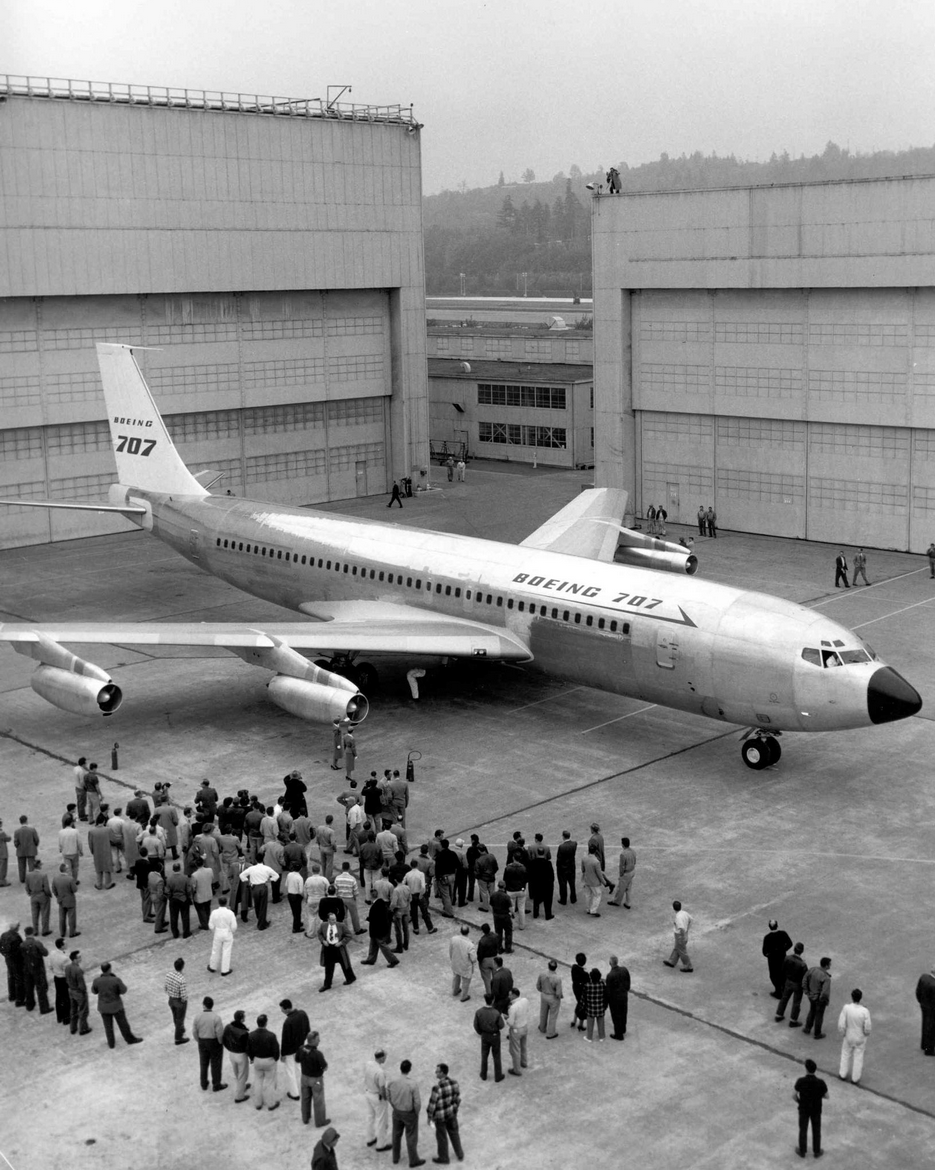
As the aerospace industry marks 69 years since the first production Boeing 707 rolled off the assembly line, ANT Industries is reflecting on the engineering advances that helped establish the modern jet age and continue to shape the manufacture of aero-engine components today.
On 28 October 1957, the first production Boeing 707 emerged from Boeing’s manufacturing facility in Renton, Washington, marking a defining moment in commercial aviation history. The four-engine aircraft represented a major advance in passenger aviation, combining jet propulsion with greater speed, capacity and range. Its introduction helped establish the foundations of modern international air travel and accelerated demand for increasingly sophisticated aerospace engineering.
The aircraft made its maiden flight on 20 December 1957, before Pan American World Airways introduced Boeing 707 passenger services between New York and Paris on 26 October 1958. For ANT Industries, a British manufacturer specialising in precision components for aero engines and industrial gas turbines, the anniversary provides an opportunity to recognise the engineering progress that has transformed aircraft propulsion over nearly seven decades.
Shaun Rowley, Managing Director of ANT Industries, said:
“The Boeing 707 was a remarkable achievement in aviation engineering. It helped change the way people travelled around the world and demonstrated what could be achieved through innovation, investment and manufacturing expertise “Nearly 70 years later, the same ambition continues to drive the aerospace industry. Aircraft engines have become significantly more advanced, and the precision required to manufacture their components has developed enormously.”
“For businesses like ANT Industries, it is fascinating to look back at these milestones and recognise how the engineering decisions made at the time helped shape the industry we work in today.”
The original Boeing 707 entered service powered by Pratt & Whitney JT3C turbojet engines, with subsequent versions introducing more advanced propulsion technology, including turbofan engines offering improved efficiency and performance. The development of commercial jet aviation created growing demand for specialist engineering capabilities, with engine manufacturers continually refining component design, materials and manufacturing processes.
Today’s aero engines operate under demanding conditions, with components required to withstand high temperatures, rotational forces and sustained operational loads while meeting stringent safety and quality requirements. ANT Industries operates within this highly specialised manufacturing environment, producing precision-engineered components for aero-engine and gas turbine applications.
The company combines advanced CNC machining capabilities with established quality management systems and specialist manufacturing expertise to support customers across the aerospace supply chain. Its continued investment in manufacturing technology, including multi-axis machining, grinding and wire EDM equipment, reflects the industry’s ongoing requirements for precision, repeatability and production efficiency.
Rowley continued:
“Every generation of aero-engine technology brings new opportunities for manufacturers to develop their capabilities. The demands placed on modern components are extraordinary, and achieving the required standards calls for considerable technical knowledge and manufacturing discipline.
“We are proud to contribute to an industry with such a rich engineering history. Our focus is on producing components to the standards our customers expect, while continuing to invest in the equipment, processes and people that will support future aerospace programmes.”
The Boeing 707’s legacy extends well beyond the aircraft itself. Its commercial success helped establish jet-powered aviation as the foundation of global air transport, creating opportunities for aircraft manufacturers, engine developers and specialist suppliers worldwide.Today, the aerospace industry continues to pursue improvements in fuel efficiency, engine performance and environmental sustainability, with advances in propulsion technology placing further demands on component manufacturers.
For ANT Industries, these developments reinforce the value of long-term investment in manufacturing capability and the specialist skills required to support complex aerospace programmes.
Rowley concluded:
“When you consider how far aviation has progressed since 1957, it gives you a real appreciation for the engineers and manufacturers who have contributed to that journey.” The Boeing 707 helped establish an entirely new era of commercial aviation. As an aero-engine component manufacturer, we are proud to play our part in the industry’s continued development and look forward to the engineering achievements that the coming decades will bring.”